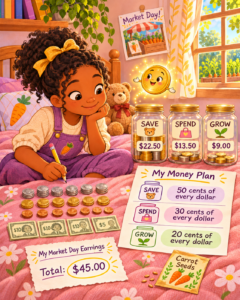
The morning after Market Day, Maya woke up with the sun. She tipped her money onto the bed and lined up her coins and bills in neat little rows. Forty-five whole dollars. She had never seen so much of her own money in one place.
She grabbed a pencil and a scrap of paper to write down her new rules, just like Penny had taught her. Thirty cents to spend. Fifteen cents to save. Five cents to plant more carrots.
Then she frowned. She added the numbers once. She added them again, counting on her fingers.
“Penny,” she said slowly, “thirty and fifteen and five only make fifty. A dollar has one hundred cents. Where did the other fifty cents go?”
Penny’s golden face lit up so brightly that the whole bedroom glowed.
“Maya! Do you know what you just did? You checked the plan. Most people never check. They make a rule, feel good about it, and never notice that half their money has nowhere to go. Money with no job has a way of disappearing.”
“So my plan was broken?”
“Your plan was a first draft,” Penny said. “Every good plan starts as a first draft. Now let’s make one where every cent has a job.”
Together, they drew three jars on the paper. Maya wrote a label under each one.
SAVE: 50 cents of every dollar, for the teddy bear.
SPEND: 30 cents of every dollar, for treats and fun.
GROW: 20 cents of every dollar, for seeds to plant more carrots.
“Fifty, plus thirty, plus twenty,” Maya counted. “One hundred! Every cent has a job!”
Then she worked out her $45. Half went into the Save jar: $22.50. Into the Spend jar went $13.50. And $9 went into the Grow jar.
That afternoon, Maya and Grandma walked to the garden shop and bought a packet of carrot seeds with the Grow money. Maya knelt in the soil and pressed each seed in with her thumb.
“These are money seeds,” she whispered to Penny.
“In a way, they are,” Penny said. “You spent nine dollars today, but you didn’t lose it. You planted it. In a few weeks, those seeds become carrots, and those carrots become more money. That is what earners do. They use some of today’s money to make tomorrow’s money.”
Maya patted the soil flat and smiled. Her teddy bear jar had $22.50 inside. Only $27.50 to go.
THE TEACHING POINT FOR PARENTS
This week, Maya caught a mistake in her own plan, and Penny celebrated it. That is the heart of this lesson: a money plan only works if every dollar has a job, and checking your numbers is a skill worth praising, not a sign of failure.
Maya also learned that some of what we earn can be planted back to earn more later. Children who understand that seeds become harvests begin to see money as something that can grow, not just something that gets used up.
CONVERSATION STARTERS TO USE THIS WEEK
- “Maya noticed her plan only added up to 50 cents. Why do you think it matters that every cent has a job?”
- “If you had three jars, Save, Spend and Grow, what would you put in each one? How would you split a dollar?”
- “Maya called her carrot seeds ‘money seeds.’ Can you think of something we buy today that helps us earn or save later?”
TRY THIS AT HOME
Give your child a dollar in coins (or ten pennies for younger children) and three cups labeled SAVE, SPEND and GROW. Let them split it however they like, then ask them to count each cup and check that it all adds back up to the starting amount. Praise the checking as much as the splitting.
NEXT WEEK ON MAYA’S MAGIC COIN
Next week: Saturday comes, the carrots are ready, and Maya is excited for her second Market Day. Then the sky turns grey. What happens to an earner when the rain won’t stop?