My Father’s Shadow: A Quiet Masterpiece on Fatherhood, Memory, and the Fragile Work of Family
Movie Review of the Week
Introduction
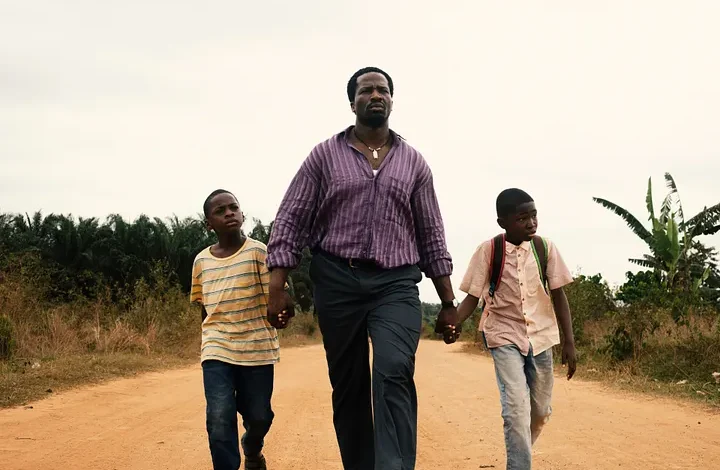
Set against the volatile political backdrop of Nigeria’s annulled 1993 presidential election, the film follows Folarin (Sopé Dìrísù), an estranged father, and his two young sons, Aki (Godwin Egbo) and Remi (Chibuike Marvelous Egbo), on a single-day journey into Lagos. The errand is simple: collect an overdue paycheck. But what unfolds between father and sons over the course of this one charged day is nothing short of a masterclass in what it means to love, sacrifice, fail, and remain present or at least attempt to for the people who need you most.
For families, family practitioners, educators, and anyone committed to the sacred work of nurturing human bonds, My Father’s Shadow is essential cinema. It does not flatter. It does not offer easy resolutions. But it does something more valuable: it holds a mirror up to the complex, sometimes heartbreaking terrain of family life and asks us to look closely and honestly.
The Architecture of Absence: When Fathers Are Present but Distant
Among the most persistent and painful challenges in family life is the phenomenon of the physically present but emotionally absent father. My Father’s Shadow puts this tension at its very center with extraordinary nuance. Folarin is not a villain. He is not cold or cruel. He is, in the fullest sense of the word, a man carrying the impossible weight of financial provision, personal shame, and unspoken love unable to collapse the distance between what he feels and what his children can receive.
Throughout the film, Folarin floats like what one reviewer describes as a “ghost, already half gone from their lives.” He is physically walking beside his sons through the buzzing arteries of Lagos, yet mentally dwelling in a private landscape of regret, financial pressure, and fatherly love he struggles to express. This is not unique to Folarin, nor to Nigerian fathers, nor to 1993. This is the portrait of millions of fathers across generations and geographies who love deeply but communicate poorly who provide materially while remaining relationally elusive.
Emotional presence requires intentionality. A parent who is physically available but emotionally absent leaves children to fill that relational gap with fantasy, anxiety, or resignation. My Father’s Shadow demonstrates that children are always watching always interpreting. The film challenges us to move beyond the question of “Is the father there?” toward the far more searching question: “When the father is there, where is he?”
Sacrifice and the Sacred Economy of Parental Love
The film’s most quietly devastating scene takes place on a Lagos beach. Folarin, sitting beside his older son Remi, tells the story of his brother. In this moment, for the first time, the father becomes fully human. His eyes carry history. His voice carries loss. And the words he speaks carry one of the film’s defining moral propositions: “Everything is sacrifice. You just have to pray you don’t sacrifice the wrong thing.”
This sentence deserves to be read slowly, more than once. In a single line, Davies Jr. through Folarin articulates the central anxiety of parenthood: not whether we will sacrifice, but whether our sacrifices will ultimately serve or damage those we love.
Folarin has sacrificed time that most nonrenewable of parental currencies in pursuit of financial provision. He works. He is away. He sends money home. In doing so, he has fulfilled one dimension of fatherhood while allowing another to wither. His sons know him as an outline rather than a full portrait. And on this one extraordinary day, the film invites us to watch as Folarin works, however imperfectly, to fill in some of that outline.
The 1993 political setting serves as a structural metaphor. A nation that promises democracy but withholds it; a system that takes labour and withholds payment; an economy that demands survival while making dignity nearly impossible all of this encircles Folarin and shapes the terms of his fatherhood. His estrangement from his sons is not only personal failure. It is also systemic. Understanding this does not excuse absence, but it deepens our compassion for it.
The Language Children Speak: Memory, Mystery, and Meaning-Making
One of the most formally daring choices in My Father’s Shadow is its approach to time and memory. The film unfolds in fragments; deliberate cuts to black, scenes that begin mid-moment, experiences that feel half-remembered rather than fully witnessed. This is an honest representation of how children experience and store significant events.
Children do not archive their childhoods the way cameras archive footage. They compress, distort, lose the boring middles, and hold tightly to the charged moments, the texture of a father’s shirt, the sound of a specific laugh, a sentence said on a beach that they won’t fully understand for twenty years.
This has profound implications for how we think about formative family experiences. Children are active meaning-makers, absorbing, interpreting, and storing experiences in ways that will shape their emotional architecture for decades. What a father says on a beach in Lagos in 1993 may become as Folarin himself seems to anticipate, the very memory that carries a son through grief thirty years later.
For parents who have been absent; physically or emotionally this is both a sobering and an encouraging message. The past cannot be recalled, but the present can be seized. Meaning can be made today. What we do in singular, concentrated moments of honesty and connection can be as powerful as years of routine.
Sibling Bonds and the Relational Ecosystem of Childhood
While the father-son relationship anchors the film, My Father’s Shadow also offers a tender, realistic portrayal of the bond between Aki and Remi, the two brothers. Cast with real-life brothers, their dynamic carries the easy, combustible intimacy of genuine siblinghood: they bicker and tease, protect and irritate, exist in that particular closeness that requires no explanation because it has simply always been.
The film subtly acknowledges that each brother has a slightly different relationship to Folarin. Remi, the older son, is the one who receives the beach story brought, however tentatively, into the territory of adult understanding. Aki, younger, experiences the day more sensorially the movement, the noise, the sheer magnitude of Lagos. Both experiences are valid. Both are incomplete. Both, together, might form something whole.
Sibling relationships are among the most underinvested resources in family strengthening. They are the longest relationships most people will ever have often outlasting parents, spouses, and friends. My Father’s Shadow invites us to see sibling bonds not merely as secondary family dynamics, but as primary ones: relationships that independently shape identity, resilience, and the long-term narrative a person builds about their family of origin.
When the World Outside Comes Through the Door: Politics, Poverty, and Family Resilience
Davies Jr. never lets us forget that the intimate story of a father and his sons is taking place inside a larger, violent, and deeply unjust story. The annulled 1993 election created an atmosphere of surveillance, anxiety, and barely-suppressed rage that permeated daily life. The film renders this atmosphere through accumulation rather than dramatisation: armed soldiers in the streets, radio reports, newspapers passed between strangers, whispered conversations.
The children absorb this tension without understanding it, which is precisely how political violence and institutional failure enter the bodies and nervous systems of children everywhere. Not through explanation, but through atmosphere. Through the tightening of a parent’s jaw. Through the slightly longer pause before a door is answered.
Folarin’s specific ordeal of working for six weeks without pay, then having to hunt down his employer is a microcosm of state-level corruption made flesh. The bureaucratic indignity he faces is felt in real time by his sons, who watch their father navigate a world that seems designed to exhaust and humiliate those with the least power. Any parent who has had to explain to their children why hard work is not always rewarded, why fairness is aspirational rather than guaranteed, this film speaks directly to their experience.
What My Father’s Shadow shows, with remarkable restraint and clarity, is that family resilience is not simply an internal, individual resource. It is built relationally in moments of shared experience, honest conversation, and witnessed struggle. Folarin does not hide his difficulties from his sons. They see him frustrated, tired, and at moments, humiliated. And in watching him persist anyway, they receive something perhaps more valuable than any story he could tell: a model of dignified endurance.
Twelve Lessons for Families from My Father’s Shadow
What follows is a distillation of the film’s most transferable insights truths drawn from fiction that carry real weight in real family life.
- Presence is not the same as availability: A father can be in the room and still be unreachable. True relational presence requires not just physical proximity but emotional attunement. Children feel the difference acutely, even when they lack the language to name it.
- Children are always watching and always interpreting: Children construct their understanding of the world and of themselves through sustained observation of their parents. What we model matters as much as what we say.
- Every sacrifice carries a cost, know what you are spending: Folarin’s sacrifice of time for provision is not malicious. But it is costly. Families benefit when parents name their sacrifices explicitly, not to burden their children, but to honour the truth of what love sometimes requires.
- Singular moments of honesty can have lifelong resonance: The beach scene carries more relational weight than years of routine. When parents choose to be truly honest; to share a story, a fear, a truth about who they are, they make a deposit in their children’s memory that can pay dividends for a lifetime.
- Memory is the archive of relationship: What children carry forward is not a comprehensive record but a curated anthology of charged moments. This gives parents both freedom (not every day must be perfect) and responsibility (some moments matter enormously).
- Economic and systemic pressures are family issues, not just social ones: The forces that keep Folarin from his children are not purely personal. Unjust economic systems and structural inequality actively undermine family bonds. Family strengthening must engage these macro-level realities alongside relational ones.
- Siblings share a childhood but not the same experience: Aki and Remi live the same day and emerge from it with different pieces of the story. Families must resist the assumption that children in the same household have had the same family experience.
- Reconciliation need not be resolved to begin: Folarin and his sons do not arrive at neat closure. But something real begins between them. Families in conflict need not wait for resolution before they begin the work of reconnection.
- Children can hold more truth than we imagine: Shielding children entirely from a parent’s humanity their struggle, their grief, their complexity deprives them of the very intimacy that makes a parent known and knowable.
- Dignity under pressure is one of the greatest gifts a parent can give: Children who see their parents maintain dignity in the face of humiliation learn, without words, that dignity is possible. This is resilience instruction in its most authentic form.
- Ordinary journeys can become extraordinary relational opportunities: The Lagos that Folarin and his sons move through together is more than setting. A trip, an errand, a commute these can become formative relational moments when parents are intentionally present within them.
- Grief and love are the same substance, differently named: The ache we feel when we lose someone is proportional to the love we held for them. My Father’s Shadow invites families to invest in love now knowing, and accepting, that grief is the cost of that investment, and that the cost is always worth paying.
Conclusion
My Father’s Shadow is not a comfortable film. It does not resolve its tensions with the ease of a fable or the efficiency of a lesson plan. But discomfort, in cinema as in family life, is often the threshold of understanding.
Watch this film with your family, and your older children. Or watch it first, and carry its questions with you into the next conversation, the next meal, the next ordinary journey that might, with intention, become something more. Ask the questions the film asks: What are you sacrificing? What are you making possible? What stories have you not yet told? What shadows have you cast, and what light do you still have time to offer?
My Father’s Shadow is, in the end, not only about a father and his sons in Lagos in 1993. It is about all of us navigating the impossible, loving imperfectly, and hoping that what we leave in the memory of the people we love will be enough to carry them forward.
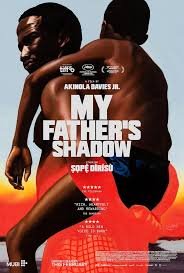
Stream My Father’s Shadow exclusively on MUBI.