
We have covered what money is and how to spend it wisely. But there is one gap that quietly does the most damage, and it is the one most parents never think to close.
Children see the spending. They rarely see the earnings.
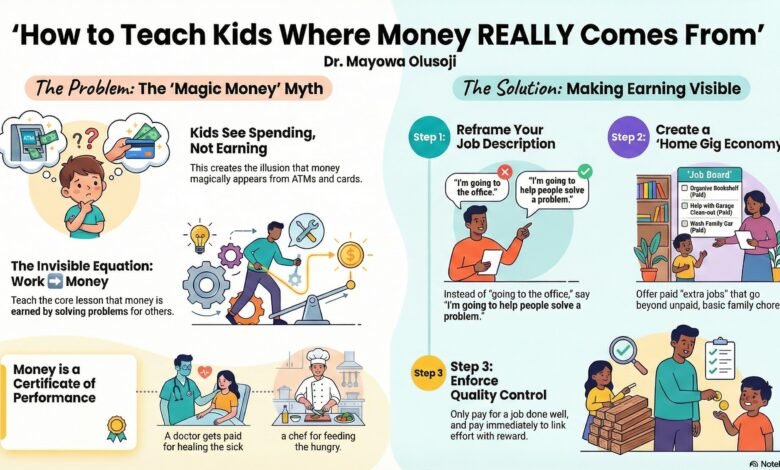
To a young child, the ATM is a magic hole in the wall; you press a button, and cash appears. To a teenager, a credit card is a wand you wave at a machine to get what you want. If we allow this myth to go unchallenged, we risk raising children who feel entirely entitled to a lifestyle without any concept of the effort required to sustain it.
This week, we dismantle the magic.
The truth your child needs to understand is this: money is a certificate of performance. It does not originate in a bank. It arrives at a bank only after a person has earned it by solving a problem for someone else.
A chef gets paid because people are hungry and cannot cook for themselves.
A doctor gets paid because people are sick and need to recover.
A developer gets paid because businesses need software to function.
The principle is simple: the bigger the problem you solve, and the better you solve it, the more you can earn. Value in, money out.
This week, change how you talk about your own work in front of your children. Stop describing your location, “I am going to the office”, and start describing your value. “I am going to help businesses fix a problem today. Because I solved that problem, I get paid. That payment is what puts food on this table.” That one shift in language does more for a child’s financial mindset than a hundred lessons about saving.
This week’s challenge: The Home Gig Economy
Do not pay children for basic household duties; those are the cost of being a family member. Instead, create a small “Job Menu” of extra tasks: washing the car, organising a drawer, polishing shoes. Assign a fair price and enforce a quality inspection before payment. In the real world, poor work does not get paid. Start that lesson early.
When they complete it well, pay them immediately. The direct link between effort and reward is the entire lesson.
Dinner table question this week:
“If you could invent something to solve one big problem for people, what would it be, and do you think people would pay for it?”
That question plants the seed of entrepreneurial thinking. Find a problem. Solve it well. Get paid. That is the entire formula, and it starts right at your dinner table.
See you next week.
Dr. Mayowa Olusoji
The Money Smart Coach
See you next week Saturday, Kindly turn on your notification for this website, so you don’t miss any episode. Have a lovely weekend.