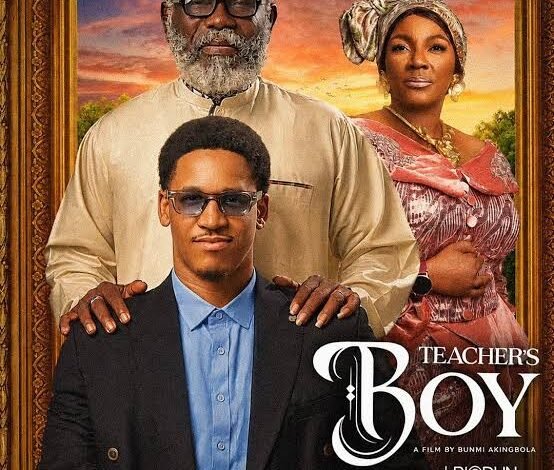
Loved, Cherished, and Chosen: How Teacher’s Boy Redefines What Makes a Father
Movie Review of the Week
There is a question that quietly follows every child through life.
It is rarely spoken aloud. Babies cannot ask it. Teenagers often hide it beneath rebellion. Adults sometimes spend decades trying to answer it without realizing they are still asking.
“Who truly wants me?”
Not who gave birth to me.
Not who shares my surname.
Not who is legally responsible for me.
Who wants me enough to stay.
Biodun Stephen’s Teacher’s Boy is, at its heart, an exploration of that question.
On the surface, it tells the story of Romade, a little boy discarded by the one person biologically designed to protect him and unexpectedly embraced by a schoolmaster who owes him nothing. But beneath that narrative lies a far more profound meditation on childhood itself. It asks us to reconsider one of society’s most enduring assumptions, that biology creates family. Instead, it proposes something far more demanding: that family is built through the repeated, ordinary acts of showing up, protecting, nurturing, and choosing a child every single day.
This is not simply a film about adoption. It is a film about attachment. It is a film about emotional inheritance. Above all, it is a film about what happens when one adult decides that a child will not face the world alone.
Children Become What They Hear
One of the film’s most unsettling achievements is that it refuses to sensationalize abuse. Romade’s childhood is not dominated by dramatic acts of violence but by something far more common and, in many homes, far more socially acceptable: emotional rejection.
His mother does not merely fail to love him well; she teaches him, day after day, that he is unwanted.
Developmental psychology tells us that children do not discover who they are in isolation. Their earliest identities are formed through reflection. They become who the significant adults in their lives repeatedly tell them they are. A child consistently met with affection begins to believe, “I am lovable.” A child consistently met with contempt begins to ask, “What is wrong with me?”
This is where Teacher’s Boy quietly becomes more than family drama. It exposes emotional abuse not as harsh parenting but as identity formation in reverse. Every insult, every dismissal, every meal withheld becomes another lesson in worthlessness.
Perhaps the greatest tragedy is that Romade never questions whether his mother is wrong. Like most children, he assumes the adult must be right. Children almost always blame themselves before they blame the people meant to protect them.
That is one of the film’s most painful truths.
The Most Powerful Protective Factor Is Often One Adult
If Romade’s mother represents developmental risk, the schoolmaster represents developmental protection.
Child development research consistently points to one of the strongest predictors of resilience: the presence of at least one stable, emotionally responsive adult.
Not a perfect adult.
Not a wealthy adult.
A present adult.
The schoolmaster becomes that protective factor.
He offers structure without fear.
Correction without humiliation.
Affection without condition.
He communicates something every child longs to hear, not merely through words but through consistent action:
“You are loved. You are cherished. You are chosen.”
Those three words carry extraordinary weight because they address the deepest injuries of abandonment. Children who have experienced rejection do not simply need shelter; they need repeated evidence that they are worth staying for.
This is where the film earns its emotional power. It understands that healing rarely begins with grand gestures. It begins with consistency.
Fatherhood Is a Verb
Perhaps the boldest argument Teacher’s Boy makes is that fatherhood is less about biology than responsibility.
Many societies continue to measure fatherhood through provision or genetics. The film quietly rejects both as sufficient.
The biological father is absent.
The adoptive father is present.
Only one truly fathers the child.
In doing so, the film echoes a truth family-strengthening practitioners have long understood: children experience parenting through relationships, not DNA. They remember who attended the school play, who stayed through illness, who listened without judgement, who kept their promises.
Fatherhood, the film suggests, is not something a man possesses. It is something he practices.
Trauma Does Not End When Childhood Ends
One of the film’s wisest decisions is refusing to suggest that love instantly erases trauma.
Adult Romade still struggles.
He mistrusts intimacy.
He anticipates abandonment.
He carries childhood into adulthood because unresolved trauma has a way of becoming the lens through which every future relationship is interpreted.
This is particularly significant in conversations about boys.
Too often, society recognises physical injuries while dismissing emotional wounds as weakness. Boys are taught resilience but rarely emotional literacy. They learn to suppress pain rather than process it.
Teacher’s Boy reminds us that neglected boys do not simply become strong men. Sometimes they become adults who desperately want love yet struggle to believe it can last.
That distinction matters.
Forgiveness Is Not the Same as Reconciliation
The return of Romade’s biological parents introduces one of the film’s most mature ideas.
Many cultures assume that family ties automatically restore broken relationships. The mere act of returning is often treated as redemption.
The film resists this.
Romade’s reluctance is not bitterness.
It is discernment.
Trust is built through repeated reliability and destroyed through repeated betrayal. It should not surprise us that rebuilding it requires more than apology.
In child protection work, reconciliation without accountability risks retraumatising the very child we claim to protect.
Teacher’s Boy wisely refuses to confuse forgiveness with restored trust.
Final Reflection
The greatest achievement of Teacher’s Boy is not that it makes us admire a good man. It is that it forces us to reconsider what every child truly needs.
Children need food.
They need education.
They need shelter.
But beneath all these lies another need that is no less essential.
They need to know that they are wanted.
Not tolerated.
Not merely provided for.
Wanted.
Loved.
Cherished.
Chosen.
In the end, Biodun Stephen offers a quiet but radical proposition: the measure of a parent is not whether a child carries your name, but whether a child carries your love with them long after they leave your home.
That is what Romade receives.
And that, perhaps, is what every child deserves.