
Dear Tieri,
One day, you will grow up in a world that will ask you to choose who deserves your respect.
Many people will tell you that age deserves respect.
Others will tell you that power deserves respect.
Still others will tell you that titles deserve respect.
Your father has learned that none of those things, by themselves, deserve admiration.
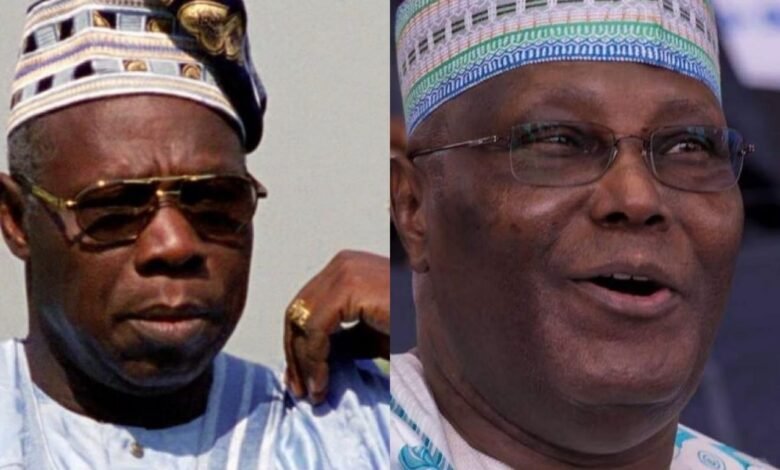
Today, our country is once again watching another public episode in the long-running political disagreement between Chief Olusegun Obasanjo and Alhaji Atiku Abubakar.
As far as I am concerned, Chief Obasanjo’s repeated reenactment of this political feud has become something of a relevance pill, perhaps even a political potion, particularly during election seasons.
My concern, however, is not Atiku Abubakar.
Neither is it whether Chief Obasanjo should support his presidential ambition.
Indeed, I do not believe Atiku, any more than many of his contemporaries, including the incumbent represents the answer to Nigeria’s present or future challenges.
He has every constitutional right to continue contesting for the presidency for as long as he chooses, and I do not begrudge him that.
But, my son, that is not the lesson I want you to take from this moment.
I want you to see something deeper.
Chief Obasanjo’s recurring interventions remind me of what I believe is one of Nigeria’s greatest leadership deficits:
Our crisis of eldership.
Too often we mistake age for wisdom.
We mistake longevity in public office for statesmanship.
We mistake influence for moral authority.
Yet they are not the same.
Our fathers understood this long before we did.
They taught us:
*”Àgbà kìí wà lọ́jà, kí orí ọmọ tuntun ó wọ́.”*
An elder should not be present while a child’s head hangs crooked.
The proverb is not really about a marketplace.
It is about responsibility.
True elders exist to prevent avoidable crises, to guide, to steady, to reconcile, and to preserve the community.
They also said:
*”Àgbà ò sí ní ìlú, ìlú bàjẹ́; bàálé ilé kú, ilé dàhóró.”*
When there are no true elders in a community, the community deteriorates. When the head of a household ceases to fulfil that role, the household descends into disorder.
My son, I hope you will remember these proverbs long after you have forgotten the names Obasanjo and Atiku.
Names come and go.
Principles remain.
I know some people may think my assessment is harsh.
Perhaps it is.
But I have no interest in confusing politeness with truthfulness. Neither do I feel obliged, for the sake of public nicety, to pretend that Nigeria has consistently produced elder statesmen in the fullest sense of that expression.
Age alone does not confer eldership.
Former office does not automatically produce statesmanship.
An elder is recognised by wisdom, restraint, moral courage, magnanimity, and the willingness to place the common good above personal grievances and wounded ego.
Mahatma Gandhi was far from perfect.
Yet he was willing to fast, at great personal cost, in pursuit of reconciliation among people whose peace mattered more to him than his pride.
That is the moral burden of true leadership:
To absorb pain for the sake of peace, not continually reopen old wounds.
For me, Chief Obasanjo is not the problem.
He is a symptom.
He personifies a broader leadership culture in which personal history too often overshadows national responsibility and where ego frequently triumphs over magnanimity.
Nigeria’s greatest deficit is not merely political leadership.
It is the scarcity of genuine elders.
So, Tieri, if life ever places you in a position where people call you an elder, do not ask whether your hair has turned grey. Ask whether your presence brings wisdom, whether your words bring healing, and whether your influence leaves people stronger than you found them.
That is eldership.
That is the inheritance I hope to leave you.
With all my love,
Dad
