ERASING FAMILY (2019): WHEN CHILDREN BECOME THE BATTLEGROUND OF DIVORCE
Movie Review of the Week
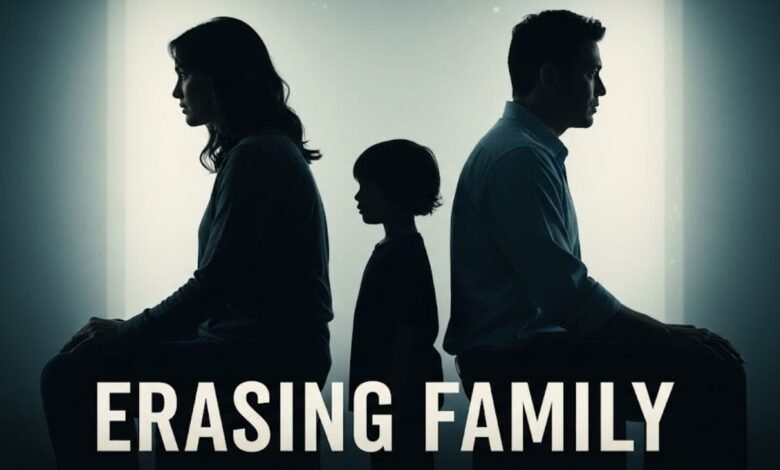
Director: Ginger Gentile
Genre: Documentary
Focus: Divorce, parental alienation, custody, family conflict and child safeguarding
This is a documentary that compel society to confront problems it would rather leave behind closed doors. The 2019 documentary examines what happens to children when divorce and parental conflict develop into prolonged battles over custody, access and the child’s relationship with one parent.
It follows families whose relationships have been fractured by divorce and, in some cases, by the deliberate or sustained exclusion of one parent from the child’s life.
From a child safeguarding and protection perspective, the film raises a question that deserves far greater attention:
What happens to the child when parents turn their unresolved conflict into a battle in which the child becomes the weapon or the shield?
That question sits at the heart of this review.
DIVORCE DOES NOT END WITH THE DIVORCE
A marriage may end through separation or divorce.
The parental relationship does not.
This is one of the most important principles that emerges from Erasing Family.
When a marriage breaks down, adults may understandably experience anger, betrayal, disappointment, grief and resentment. These emotions can become particularly intense where the circumstances surrounding the separation involve infidelity, domestic violence, financial disputes, abandonment or other serious grievances.
But the existence of legitimate adult grievances does not remove the child’s rights.
The child remains entitled to safety, care, stability and protection from unnecessary emotional harm.
The documentary demonstrates what can happen when this distinction is lost.
The conflict between adults begins to determine the child’s relationship with each parent. One parent becomes the primary parent. The other becomes a visitor. In the most severe situations, the other parent is effectively erased from the child’s life.
That is where a family dispute can become a child safeguarding concern.
WHEN CHILDREN BECOME SWORDS AND SHIELDS
One of the most disturbing patterns in embattled relationships is the use of children as instruments of adult conflict.
A parent may withhold access to punish the other parent.
A parent may refuse to return the child.
A parent may remove the child from the jurisdiction.
A parent may abandon the child altogether.
A parent may repeatedly speak negatively about the other parent until the child begins to internalise that narrative.
In some cases, the child becomes the messenger.
In others, the child becomes the witness.
In others, the child becomes the judge.
And in the most damaging situations, the child becomes the weapon.
This is precisely why custody disputes cannot be approached merely as contests between adults.
The child is not property to be won.
The child is not evidence to be deployed.
The child is not leverage.
The child is a human being whose life continues after the adults have finished fighting.
Erasing Family gives this reality a human face. One child describes drawing a house divided into two, with different family members on opposite sides.
That image captures the psychological position of many children caught in high-conflict separations.
They are not simply moving between two homes.
They are often navigating two competing worlds.
PARENTAL ALIENATION: THE CHILD CAUGHT BETWEEN TWO NARRATIVES
The documentary pays particular attention to parental alienation and the ways in which a child’s perception of a parent can be influenced by the conduct and narrative of the other parent.
Children naturally trust their caregivers.
When a parent repeatedly communicates that the other parent is dangerous, wicked, uncaring or unworthy of love, the child may not possess the maturity to independently assess those claims.
The documentary illustrates this process through children who begin to repeat narratives they have heard from adults around them. It also presents the severe and lasting psychological consequences that can follow prolonged alienation.
From a safeguarding perspective, this raises an important concern.
Children should be protected from adult conflict, not recruited into it.
At the same time, child protection must be careful not to make the opposite mistake.
A genuine disclosure of abuse must never be dismissed as “parental alienation” simply because it is made during a custody dispute.
There must be careful, independent assessment.
The principle should be:
Protect children from unsafe parents while also protecting them from the unjustified loss of safe parental relationships.
THE BEST INTERESTS OF THE CHILD CANNOT BE AN AFTERTHOUGHT
One of the recurring concerns in the documentary is the gap between the stated objective of family justice and the lived experience of children going through family disputes.
The family court is expected to consider the child’s best interests.
Yet the documentary portrays a system in which adversarial proceedings can intensify hostility between parents. It describes cases that take months to resolve, leaving children exposed to prolonged uncertainty and conflict.
This is an important child safeguarding question.
Can a process designed to determine what is best for a child inadvertently expose that child to further harm?
The answer requires us to look beyond the eventual court order.
A custody order may determine where a child lives.
It does not automatically repair the child’s emotional wounds.
A court may determine access.
It cannot automatically restore trust.
A legal judgment may conclude a dispute.
It does not necessarily end the child’s experience of the dispute.
THE CHILD DOES NOT STOP BEING A CHILD WHEN THE CASE ENDS
This is perhaps one of the documentary’s most powerful messages.
The legal system may eventually close a case.
The child’s experience continues.
Erasing Family features young people who describe the effects of prolonged family conflict years after their parents’ separation. Some struggle with their understanding of family relationships and with the emotional consequences of losing contact with a parent.
One of the film’s observations is particularly striking. A young person involved in one of the cases expressed frustration that, after the legal proceedings, nobody came back to ask how she was doing.
This exposes a weakness that deserves attention in family justice and child protection systems.
Who follows up on the child?
Who asks whether the child has adjusted?
Who asks whether the child is frightened?
Who asks whether the child still has a relationship with both parents?
Who asks whether the child is being emotionally manipulated?
Who asks whether the child is thriving?
A child-centred system cannot stop at the court order.
SEPARATION DOES NOT JUSTIFY JUNGLE JUSTICE
There is an important qualification.
There are circumstances in which removing a child from a parent is necessary.
Where there is credible evidence of domestic violence, sexual abuse, serious neglect, exploitation or another significant threat to the child’s safety, protective intervention may be necessary.
But such decisions should not become an excuse for unilateral parental punishment.
Where a parent believes that the other parent poses a danger to the child, the appropriate response should involve the law and qualified child protection professionals.
The answer to one form of injustice cannot be another form of injustice.
A parent cannot simply decide that because the marriage has broken down, the other parent has lost all parental rights.
Equally, a parent accused of abuse cannot demand access simply by invoking parental rights.
The child must remain at the centre.
WHERE ARE THE VOICES OF REASON?
Another issue raised by this discussion is the importance of early intervention.
By the time some couples reach the point of divorce, they have rejected nearly every voice of reason around them.
Family members take sides.
Friends take sides.
Religious leaders may take sides.
Counsellors may become involved only after the conflict has become severe.
The people who could once have helped the couple think clearly may become participants in the dispute.
The result is devastating.
The parents are consumed by their conflict.
The child is left at their mercy.
This is why family strengthening cannot begin only when a custody case reaches court.
Families need access to appropriate counselling, mediation, psychosocial support and legal guidance before the conflict becomes irreparable.
MEDIATION MAY OFFER A DIFFERENT PATH
One of the documentary’s more constructive contributions is its examination of mediation.
The film presents mediation as a possible alternative to prolonged courtroom conflict where parents are capable of participating safely and meaningfully. The objective is to help parents reach arrangements that serve their children rather than simply produce a winner and a loser.
That distinction matters.
A courtroom judgment may produce a winner.
A child needs parents who can continue to function as parents.
The documentary makes the point that after an adversarial trial, it can be extremely difficult for parents to return to cooperative parenting because they have spent days attacking one another.
This is why mediation, where safe and appropriate, deserves greater consideration in family dispute resolution.
WHAT DOES THIS MEAN FOR CHILD SAFEGUARDING?
From a child safeguarding and protection perspective, using children as swords or shields in an embattled relationship can expose them to:
Emotional abuse
Children may be exposed to hostility, manipulation, threats and pressure to choose sides.
Neglect
Parents consumed by conflict may lose sight of the child’s everyday emotional, educational and developmental needs.
Psychological harm
Children may experience anxiety, guilt, confusion, divided loyalties and difficulties developing healthy relationships.
Loss of meaningful parental relationships
A child may unnecessarily lose contact with a parent who could otherwise provide love, care and support.
Exposure to adult matters
Children may become repositories for information about infidelity, finances, court proceedings, violence and other matters they are not equipped to carry.
Long-term family disruption
The consequences can continue long after the marriage and court proceedings have ended.
These are not simply family law concerns.
They are child protection concerns.
THE FILM’S MOST IMPORTANT LESSON
The documentary ultimately challenges the idea that divorce is only an issue between two adults.
Once children are involved, the consequences extend beyond the marriage.
Parents may have the right to end a marriage.
They do not have the right to make their children carry the emotional cost of that decision.
A child should not have to choose between parents.
A child should not be required to prove loyalty.
A child should not become the punishment for an unfaithful spouse.
A child should not become the reward for a successful custody battle.
And a child should never become the battleground upon which two adults continue a war that began with their marriage.
OUR TAKE
Erasing Family is a difficult but necessary documentary.
Its greatest value is that it shifts attention from the question:
“Which parent won?”
to the question:
“What happened to the child?”
That is the question that child safeguarding professionals, family lawyers, mediators, courts, schools, employers and, most importantly, parents must keep asking.
Where separation becomes inevitable, the goal should not be to preserve a failed marriage at all costs.
The goal should be to prevent a failed marriage from becoming a failed childhood.
Parents may cease to be spouses.
They remain parents.
And whatever bitterness exists between them, the best interests, safety, dignity and emotional wellbeing of the child must remain the first consideration.
THE QUESTION WE LEAVE WITH YOU
When a marriage breaks down, will the adults fight over who gets the child, or will they work together to ensure that the child does not lose both parents in the process? Because the child did not cause the marriage to fail. The child should not have to pay for its failure.
“Erasing Family (2019) | Full Documentary About Parental Alienation” is available to watch on YouTube.