MOVIE REVIEW OF THE WEEK: Raising Parents (2025)
UNICEF's Quietly Radical Documentary Dares to Ask: Who is Looking After the People Raising Our Precious Children?
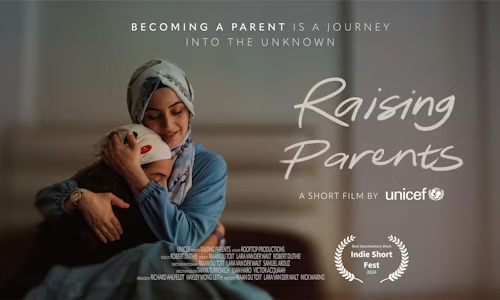
Directed for UNICEF Global 2025 – 24 minutes
Available on Apple TV, Amazon Prime , Roku TV
Premiered: June 1, 2025 — International Day of Parents
This intimate documentary asks a question many communities avoid: Who is caring for the people raising children?
We often celebrate children’s milestones, school success, laughter, and growth. Yet behind those moments are parents and caregivers carrying exhaustion, doubt, grief, anxiety, financial pressure, loneliness, and the constant fear that they may be failing those they love most.
A Different Kind of Parenting Story
Rather than offering advice, formulas, or polished ideals, the film gives us something more valuable: real families telling real truths.
Across four countries, viewers meet parents navigating very different realities:
- In Bolivia, a family raising a child with autism learns to understand joy through a different lens.
- In Türkiye, a mother balances grief and motherhood after a devastating earthquake.
- In Thailand, a couple reflects on how the pandemic tested their relationship and parenting life.
- In South Africa, a mother speaks openly about postpartum depression, guilt, and seeking help.
These stories differ in culture and setting, but they are joined by one truth: parenting is human work, and human beings need support.
Purposeful Parenting Means More Than Providing
Too often, parenting is reduced to feeding children, paying fees, enforcing rules, or meeting public expectations. But purposeful parenting goes deeper.
Purposeful parenting means:
- being emotionally present
- learning and adapting
- seeking help when overwhelmed
- creating safety, not only structure
- understanding a child’s uniqueness
- raising children with intention, not mere reaction
This film reminds us that parents cannot pour endlessly from an empty vessel.
Mental Health Is a Parenting Issue
One of the strongest messages in Raising Parents is that parental mental health is not separate from child wellbeing. When parents are chronically stressed, burnt out, depressed, isolated, or unsupported, the effects reach the home. It shapes patience, communication, consistency, bonding, and emotional climate. When parents receive care, children often receive better care.
This is why conversations about child development must include:
- parental stress
- maternal and paternal mental health
- community support systems
- economic pressure
- family-friendly workplace policies
- access to counselling and social care
Breaking the Myth of the Perfect Parent
Many mothers and fathers suffer quietly because they believe struggle means failure.
The film challenges that lie.
Struggle may mean:
- you are carrying too much
- you need rest
- you need support
- you are adjusting to change
- you are grieving
- you are human
There is no perfect parent. There are only growing parents.
Why This Film Matters
In many homes, especially across African societies, parents are expected to endure silently. Emotional distress is hidden. Asking for help is judged. Parenting burdens are normalized. That silence has a cost. Raising Parents offers language for what many parents feel but cannot say. It creates dignity around vulnerability and reminds society that raising children should never be a solitary assignment.
Who Should Watch This
Every parent who has ever swallowed the question am I doing enough? and carried it silently through another day. Every partner who has wondered why the person they love seems unreachable. Every policymaker who has signed off on a family welfare report without ever sitting in a room with a parent who is quietly drowning.
And every professional; therapist, midwife, teacher, social worker who works with families and wants to understand what they are actually carrying through the door.
Raising Parents is not a film about failure. It is a film about the courage it takes to keep going, to ask for help, and to recognise that the love behind the struggle is itself a form of extraordinary strength. When we support parents, we strengthen families, communities, and society itself
Raising Parents is not simply a documentary about parents. It is a call to families, institutions, employers, faith communities, and governments to understand that when we strengthen parents, we strengthen children.