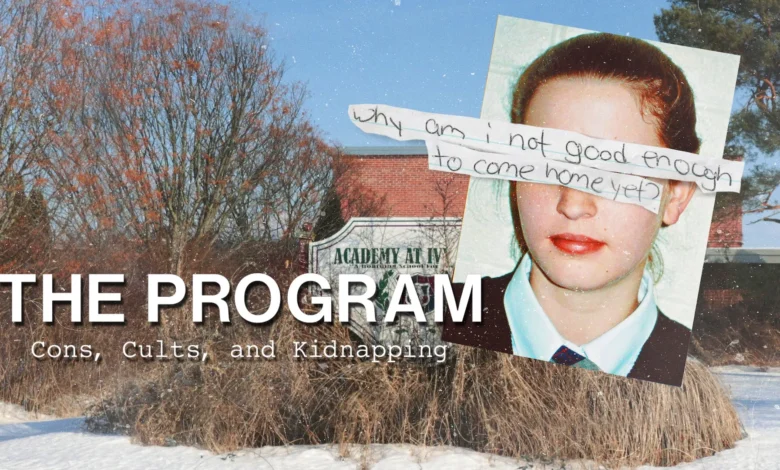
Katherine Kubler was fifteen or sixteen years old when she was sent to the Academy at Ivy Ridge, a behaviour modification facility near the Canadian border in upstate New York, packaged and sold to her family as a boarding school. Decades later, she picked up a camera. The result is The Program: Cons, Cults, and Kidnapping one of the most powerful, necessary, and emotionally shattering documentaries released in 2024, now available on Netflix.
This is not comfortable viewing. Kubler makes no effort to soften the experience, and she is right not to. What happened at Ivy Ridge and at countless sister facilities operating under the same umbrella of the so-called “troubled teen industry” was not a series of isolated incidents. It was a system, deliberately constructed, financially incentivised, and legally enabled. The Program exposes that system with the rigour of investigative journalism and the emotional depth of memoir.
The Academy at Ivy Ridge operated from 2001 to 2009 in Ogdensburg, New York. Marketed to anxious parents as a therapeutic boarding school for “troubled teens,” it was, by the accounts of dozens of survivors, something far darker: a behaviour modification facility that employed cult-like isolation tactics, psychological manipulation, physical control, and a points-based incentive system designed to ensure total compliance.
Teenagers, most between 14 and 17 years old were frequently transported to the facility against their will, often by private “escort” companies hired by parents, who arrived in the middle of the night without warning. Many survivors describe this experience as traumatising in itself, a violation before they had even crossed the facility’s threshold.
Once inside, students were stripped of their personal possessions, subjected to invasive searches, cut off from outside communication, and placed in a rigid hierarchical system. Writing letters home that revealed the true conditions could result in punishment. Calling for help was not an option.
Once taken there, the youths were cut off from the outside world, forced to adhere to strange guidelines and, in some instances, allegedly physically abused, beginning with the strip search to which they were subjected on arrival. The facility has since closed, but its legacy and the industry it represented remains devastatingly active. Kubler’s documentary is as much a warning about the present as it is a reckoning with the past.
What elevates The Program beyond the personal into the structural is its unflinching examination of the industry that made Ivy Ridge possible. The troubled teen industry in the United States is a multi-billion-dollar enterprise, largely unregulated, that has operated in legal and ethical grey zones for decades. Facilities open under one name, attract regulatory scrutiny, close, and reopen under another, often under the same ownership, in a different state.
The documentary’s contextualisation of parental complicity is handled with notable nuance. Kubler does not let parents off the hook, the betrayal felt by survivors is real and must be acknowledged. But she also traces the way in which those parents were themselves deceived, fed a language of “therapeutic intervention” and “structured environment” that obscured what was actually happening inside. The result is a web of exploitation in which the children at the bottom bore all the suffering.
One of the most valuable contributions of The Program is the conversation it forces about how societies respond to struggling young people. The troubled teen industry is, at its core, a symptom of a broader cultural failure, a failure to distinguish between discipline and punishment, between structure and coercion, between therapeutic care and institutional control.
Research and global practice are consistent on this point. Children do not develop resilience, empathy, or self-regulation through fear and humiliation. They develop these capacities through safety, relationship, and the experience of being treated as capable human beings. Iceland’s prevention-focused youth development model which has produced measurably healthier young people across a range of indicators stands in sharp contrast to the punitive, isolationist approach represented by Ivy Ridge and its peers.
Barack Obama has spoken openly about experimenting with marijuana in his youth. His caregivers responded with dialogue and accountability rather than force. The lesson is not unique to him, it is systemic. Coercive responses to adolescent struggle do not produce better outcomes; they produce longer-lasting trauma, deeper mistrust, and greater barriers to genuine rehabilitation.
The Program does not just ask why Ivy Ridge existed. It asks why we keep creating institutions like it and what we must change, structurally and culturally, to stop.
Conclusion
The Program: Cons, Cults, and Kidnapping is difficult viewing because it reveals uncomfortable truths. It reminds us that harmful systems do not always arrive wearing the appearance of danger. Sometimes they arrive carrying promises of protection, discipline, and help.
The documentary is painful, unsettling, and at times heartbreaking. Yet it is also necessary.
Its greatest contribution is forcing society to reconsider what it means to truly care for children. Because discipline should never strip away dignity. Children are not projects to be fixed, they are human beings to be guided, protected, and understood.