CHILDREN SPOTLIGHT OF THE MONTH
The Crayon Girl: How Ella Tryon Turned a Hospital Experience into a Nationwide Mission to Bring Joy to Children
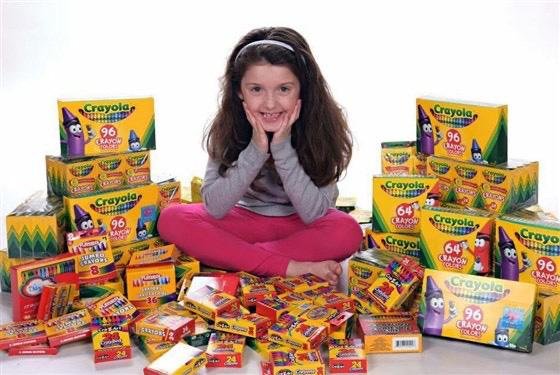
In 2016, six-year-old Ella Tryon was a patient at Rainbow Babies & Children’s Hospital in Cleveland, Ohio. She was undergoing treatment and, like many children who spend time in hospital, she wanted something simple to help make the experience a little easier.
Ella wanted to colour.
More specifically, she wanted to colour a rainbow.
But there was a problem: there were not enough suitable crayons available for every child, and because of infection-control concerns, crayons used by one patient could not simply be passed on to another. Reports from the time describe the available crayons as worn and insufficient for the number of children needing them.
For Ella, this was more than an inconvenience.
She began thinking about the other children who would come to the hospital after her.
“I didn’t want other children like me to have that same experience.”
That thought became the beginning of something much bigger.
From One Child’s Experience to a Nationwide Mission
Ella initially told her parents that when she recovered, she wanted to return to the hospital with crayons for the children.
Her parents imagined buying a few cartons and dropping them off.
Ella had a different idea.
She wanted every child to have their own box of crayons.
Her family began involving the community. Collection points were established at local fire departments, her church and her karate school. The campaign spread through Facebook, and local media soon picked up the story. Ella became known as “The Crayon Girl.”
The response was extraordinary.
Within weeks, thousands of boxes had been collected. By October 2016, reports indicated that more than 13,000 boxes had been gathered, alongside hundreds of colouring books.
But Ella did not stop at one hospital.
Her vision expanded to children’s hospitals across the United States.
Help Me Color A Rainbow
With the support of her parents and community, Ella’s campaign developed into the nonprofit Help Me Color A Rainbow.
The organization’s mission was rooted in a remarkably simple idea: children in hospital deserve opportunities for creativity, comfort and normal childhood experiences while receiving care.
Over the following years, Ella delivered crayons to children’s hospitals in different parts of the United States. Reports documented donations to hospitals including Rainbow Babies & Children’s Hospital, Cleveland Clinic Children’s Hospital, Primary Children’s Hospital in Utah and hospitals in Tennessee and Pennsylvania.
In 2019, reporting on Ella’s work stated that she had surpassed 40,000 boxes of crayons.
By the time Scholastic profiled her in 2020, the organisation had donated more than 49,000 boxes of crayons to children’s hospitals.
That is an extraordinary achievement for an idea that began with a six-year-old simply wanting to colour a rainbow.
The Mission Continued
Ella’s story did not end with the early media attention.
Publicly available information associated with Ella and Help Me Color A Rainbow shows that the initiative continued making deliveries. Ella’s LinkedIn profile includes updates about additional hospital deliveries, including a post stating that two more deliveries would bring the organization’s total to more than 46,000 boxes delivered across the United States, as well as another update about 2,000 boxes being delivered to two hospitals.
Because publicly indexed sources contain different milestone figures from different periods, it is safer to describe 49,000+ boxes as a documented milestone reached by around 2020, rather than claim that this is necessarily the organization’s final or current 2026 total.
That distinction matters when telling children’s stories.
Good storytelling should inspire without sacrificing accuracy.
More Than Crayons: A Lesson
At first glance, Ella’s story appears to be about crayons.
It is actually about something much deeper.
Ella experienced a problem herself. Instead of dismissing her concern as something small or unimportant, her parents listened. They supported her idea and helped her turn it into action.
This reflects an important principle in child safeguarding:
Children have a voice—and adults have a responsibility to listen.
Children often notice things adults overlook.
A child may identify that something feels unsafe, unfair, uncomfortable or inaccessible long before an adult recognizes the problem.
When children are encouraged to speak and adults take their concerns seriously, children learn that their voices matter.
Ella’s story demonstrates the positive side of child participation: she identified a need, expressed her concern, proposed a solution and was supported by adults to make a difference.
Safeguarding Is Also About Dignity
Safeguarding is not only about preventing abuse.
It is also about creating environments in which children are treated with dignity, respect, care and consideration.
A hospital can be a frightening and unfamiliar environment for a child. Medical procedures, separation from family, pain, uncertainty and long periods in a hospital room can affect a child’s emotional wellbeing.
Something as simple as a box of crayons cannot remove those difficulties.
But it can give a child something important:
Choice.
Creativity.
Normality.
A moment of joy.
And sometimes, those small moments matter.
Conclusion
Ella’s story challenges another common assumption: that children must wait until they are adults before they can contribute meaningfully to society.
They do not.
Children can identify problems.
Children can suggest solutions.
Children can influence their communities.
Children can demonstrate empathy.
Children can lead.
Adults, however, have a critical role to play.
We must provide the safe structures, guidance, resources and boundaries that allow children’s ideas to develop without placing children at unnecessary risk.